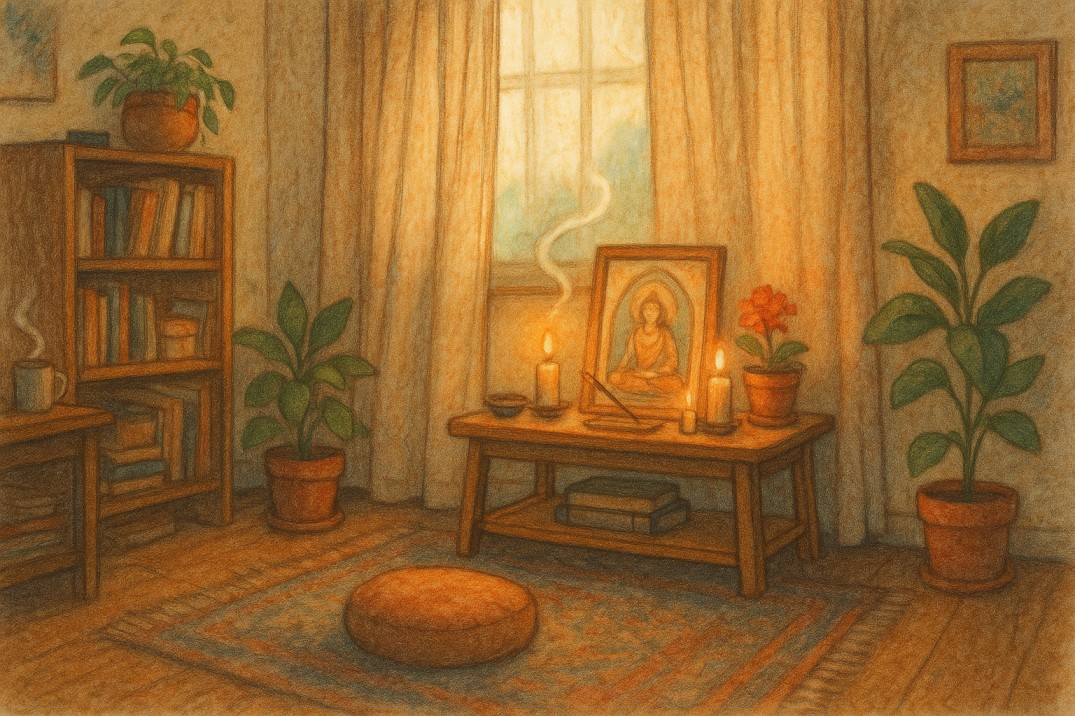
How to Build a Sacred Space at Home with Things You Already Own
There is a strange modern idea that peace is something you have to travel to.
As if stillness lives in a retreat center, in nature, or in the perfect house where no one leaves dishes in the sink.
But here is the truth about inner peace. It is not far away, it is not somewhere, it is where you set it to be.
A sacred space is an invitation.
Not a shrine to impress anyone, not a spiritual display case, not a corner where you perform spiritual practices. It is a small, modest place in your home that whispers, “Peace.”
You do not need to buy a sacred space. You need to notice that your home is already full of materials to build one.
What a sacred space really is
A sacred space is not holy because of what it contains.
It becomes meaningful because of how you relate.
You create a boundary, not to exclude life, but to enter it with clarity. You return to the same spot again and again, and that repetition softens the mind. It teaches the body: this is where we pause.
In Buddhist practice, it is very simple.
- A place to sit
- A reminder of presence
- A small ritual of returning
That is enough.
Choose the spot with one rule: it must be easy to return to
A practice corner fails when it is inconvenient. The mind will always bargain. The body will choose the familiar route.
Choose a place that welcomes repetition.
- A corner of your bedroom
- A windowsill
- A small shelf
- A section of your desk that can stay uncluttered
- A low table or even a simple cushion on the floor
If you can, choose a place with natural light. Morning light is a teacher. It changes without asking permission. It reminds you that everything is impermanent, including your mood.
Clear the surface like you are clearing the mind
In Buddhist temples there is often a sense of simplicity. Not because simplicity is moral, but because it makes attention easier.
Start by clearing.
- Remove clutter from the surface
- Keep only what supports quiet and presence
- Use a tray, cloth, or board to define the boundary
A boundary matters. Not as a fence, but as a gentle container. A tray can do what a wall cannot. It tells the mind: this is the practice area.
Build the space with the “three supports”: form, light, and life
You do not need special items. Use what you have. The principle matters more than the object.
Form (a simple container)
- A tray
- A wooden board
- A folded cloth
- A plate or shallow bowl
In many Eastern homes, a cloth or mat is enough. It signals intentionality. The moment you place it down, you have already begun.
Light (wakefulness)
- A candle
- A small lamp
- A window that catches morning sun
Light is not just atmosphere. It is a symbol of awareness. Not dramatic awareness, just the quiet kind that sees clearly.
Life (impermanence in a friendly form)
- A plant
- A small branch
- Flowers
- A bowl of water with a leaf
In Eastern traditions, flowers appear often for a reason. They are beautiful, and they do not last. They teach without speaking. They remind us that clinging creates suffering, and that change is not a mistake. It is the nature of things.
Here is a simple example.
On a small shelf you might place a folded cloth, a candle, and one living thing, like a cutting in water or a small plant. That is already a complete space. Nothing dramatic. Just a place that says, return here.
Choose one centerpiece object, and make it your reminder
Traditionally, an altar might include an image of a divine being, but you do not need to imitate forms you do not connect with. The point is not to cosplay a tradition. The point is to remember the presence of life.
Your centerpiece object can be very simple.
- A stone from a meaningful place
- A small bowl
- A photo of a teacher or ancestor
- A bead, mala, or bracelet you already wear
- A simple handwritten word like “Here” or “Breathe”
Place it in the same spot every time. Consistency turns ordinary objects into practice.
If you want, you can also use a personal object as an intention anchor, something you touch daily that holds meaning. Not as superstition, but as a way to bring attention into the hands.
Add one sensory layer, and keep it quiet
A ritual space is not meant to overwhelm you. It is meant to settle you.
Choose one sensory support.
- Sound: a gentle track, a bell sound, or a few minutes of soft music
- Scent: tea, citrus peel, a clean soap nearby
- Touch: a textured cloth, a smooth stone, a warm mug
Sound can be especially helpful because it changes the atmosphere instantly. A short, intentional audio piece can create a soft container for practice. This is why short-form sound experiences can work so well for daily ritual.
Keep it non-performative, let it be lived-in
A practice space becomes powerful when it becomes normal.
Not a special setup for special moods, but a place you return to when you are stressed, distracted, joyful, tired, or blank.
The goal is not to be calm.
The goal is to be present.
If your mind is loud, let it be loud, and sit anyway. The space is not there to control experience. It is there to meet it.
A simple maintenance rhythm (the practice of tending)
In many Eastern traditions, tending the space is part of the practice. Cleaning is not a chore, it is mindfulness with hands.
Once a week, do a gentle reset.
- Remove anything that drifted in
- Refresh the water
- Replace the flower or branch if you use one
- Wipe the surface slowly, like you are wiping your own mind
- Simplify if it starts feeling crowded
This is how the space stays alive.
Not through perfection, through attention.
A short ritual you can do there (under a minute)
- Sit or stand in front of the space
- Look at one object, just one
- Take one slow inhale
- Take one long exhale
- Notice one sensation in the body
- Whisper one sentence
Not as a philosophy, but as an experience.
Closing: the real purpose of the space
A sacred space is not a place where life becomes spiritual. It is a place to recognize life at its most overlooked time. The pure present moment.
The irony is that we search for transcendence while ignoring what is happening right now. We look for awakening as if it is hidden somewhere else, in some better moment, in a better version of ourselves.
So give yourself a corner where you can stop running long enough to notice.